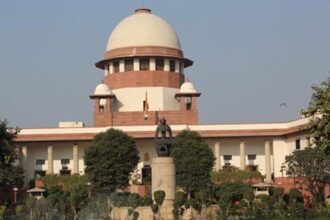

The Supreme Court on Thursday ordered that the University Grants Commission (Promotion of Equity in Higher Education Institutions) Regulations, 2026 be kept in abeyance till further orders.
A Bench comprising Chief Justice of India Surya Kant and Justice Joymalya Bagchi expressed serious reservations about the Regulations, observing that they are prima facie vague and capable of misuse. The Court noted that the Regulations may lead to discrimination against general category students.
Regulations to Be Reviewed by Expert Committee
The Court suggested that the Regulations should be revisited by a committee of eminent jurists who understand social realities and constitutional values. Addressing the Solicitor General, the CJI stated that such a committee should carefully examine how the Regulations impact social harmony and behaviour within educational institutions.
2012 UGC Regulations to Continue
The Court issued notice to the Union Government and the UGC, returnable on March 19. Until then, the UGC Regulations of 2012 will continue to operate.
Key Concerns Raised by the Court
The Bench highlighted several concerns during the hearing:
- The provisions are vague and open to misuse
- Separate definition of “caste-based discrimination” is unnecessary when “discrimination” is already broadly defined
- Ragging has not been addressed under the Regulations
- The assumption that only caste-based discrimination exists in campuses is flawed
Petitioners’ Arguments
The Regulations were challenged through writ petitions filed by Mritunjay Tiwari, Advocate Vineet Jindal, and Rahul Dewan.
Advocate Vishnu Shankar Jain, appearing for one petitioner, argued that Regulation 3(1)(c) defines caste-based discrimination only in favour of SC, ST, and OBC communities, excluding general category students. He submitted that this violates Article 14 of the Constitution.
He further argued that since Regulation 3(1)(e) already defines discrimination in general terms, a separate caste-based definition is redundant and discriminatory.
Court’s Observations on Social Impact
The CJI questioned whether India is moving away from the idea of a casteless society, noting that economic progress has also occurred within scheduled castes. The Court strongly criticised the idea of separate hostels based on caste, stating that such measures could divide society further.
Justice Bagchi emphasized that India’s unity must be reflected in educational institutions.